If you live in Franklin, TN and you're living with neuropathy, you already know the script. Your feet burn at night. Your hands go numb while you're driving. You stumble on stairs you used to take two at a time. You tell your doctor, and after a quick reflex check you get handed the same answer every time:
"There's not much we can do. Let's try a nerve medication."
So you start gabapentin, or pregabalin, or maybe an antidepressant repurposed for nerve pain. The dose climbs. The side effects pile on — brain fog, dizziness, weight gain. And underneath it all, the burning, numbness, and tingling keep creeping further up your legs and arms.
Nobody ever asks the one question that actually matters: why are your nerves dying in the first place?
That's the question conventional medicine skips. And it's exactly why so many people in Franklin, Brentwood, Spring Hill, and across Middle Tennessee watch their neuropathy slowly worsen year after year — while the underlying cause is never even investigated.
Let me be very clear: neuropathy is not a gabapentin deficiency. It's a cellular problem — your nerves are starving — and with the right detective work, that process can often be slowed, stopped, and in many cases reversed.

"Numbing nerve pain with medication is not the same thing as feeding the nerves so they can actually heal."
The Real Problem: Nerve Starvation, Not "Bad Nerves"
Here's what almost every neuropathy patient in Franklin, TN misunderstands: the burning, numbness, and tingling are the symptoms, not the disease. The disease is nerve starvation — your peripheral nerves are slowly being deprived of the oxygen, nutrients, and cellular energy they need to survive.
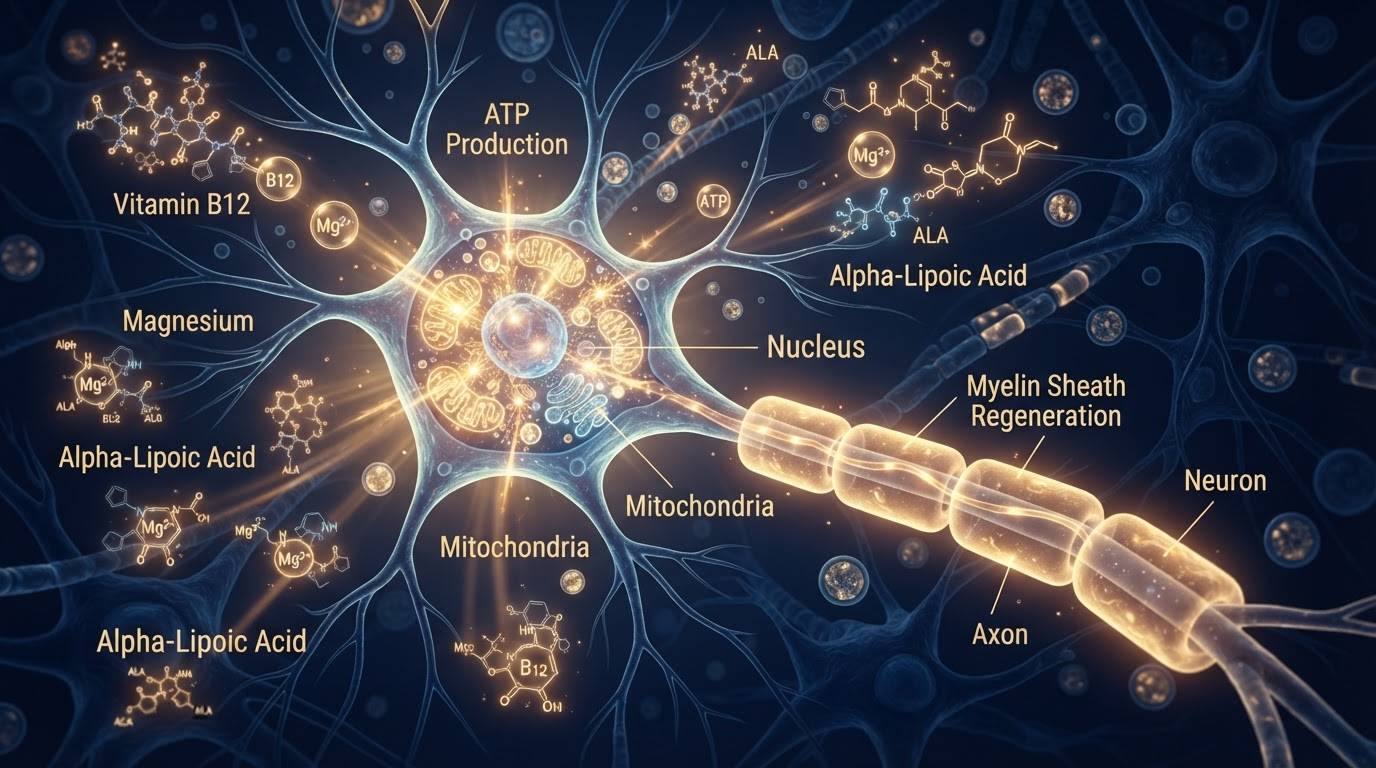
Your peripheral nerves are the longest cells in your body. The nerve that reaches your toes starts in your spinal cord and has to ship every bit of fuel and oxygen all the way down to the foot — a journey of three feet or more. That fuel travels through tiny powerhouses inside the nerve called mitochondria. When those mitochondria can't produce enough energy (ATP), the farthest ends of the nerve — your feet and hands — die first.
That's why neuropathy almost always starts in the toes and fingertips and works its way inward. It's not random. It's the predictable pattern of a nerve running out of fuel from the far end back toward the center.
Medications like gabapentin turn down the volume on the pain signal. But they never address why the nerve is starving in the first place. So the nerve keeps dying silently — even while the pain is temporarily muted — until eventually the numbness replaces the burning, and you've lost the protective sensation that keeps you from burning your feet or breaking a toe without knowing it.

Why Neuropathy Is So Poorly Managed in Standard Healthcare
The conventional model has a built-in flaw: it's designed to manage neuropathy, not reverse it. Here's what that looks like in practice for most Franklin, TN patients:
- Symptom suppression over root-cause resolution. You're handed a nerve medication and told to come back in six months. The dose increases, the burning spreads, and nobody asks why your nerves are dying.
- "It's just diabetes" — and then they stop looking. If you have diabetes, neuropathy is written off as an inevitable complication. But diabetes is only one of dozens of possible drivers, and many people with "perfect" blood sugar still develop severe neuropathy.
- Incomplete diagnostic workups. Standard care runs a basic blood sugar and maybe a B12, then calls it a day. It skips the fasting insulin, thyroid, toxin, nutrient, and gut testing that reveal the true drivers of nerve starvation.
- No pathway to nerve regeneration. Conventional care focuses on lifelong symptom management rather than restoring the cellular environment nerves need to actually repair and remyelinate.
The "Manage It Forever" Trap
Gabapentin tells your brain to stop listening to the fire alarm. It never puts the fire out. While the alarm is muted, the house keeps burning. Functional medicine is the arson investigation — we find what's starving the nerve and restore the fuel so the nerve can actually heal.
The Labs Standard Neuropathy Care Never Runs
Standard neuropathy care checks two things: a basic blood sugar and maybe a B12. Both are useful, but both are late and incomplete markers. To actually stop nerve starvation, we have to look upstream. Here are the labs a functional medicine workup for neuropathy in Franklin, TN should include:
1. Fasting Insulin & HOMA-IR
Insulin resistance damages the tiny blood vessels that feed your nerves long before your A1C ever rises. Those microvessels are the only supply line delivering oxygen and nutrients to the nerve. Fasting insulin and HOMA-IR reveal this vascular damage years — sometimes decades — before standard diabetes testing catches it.
2. Comprehensive Thyroid Panel
Low thyroid function slows your metabolism and reduces blood flow to your extremities — starving your nerves of oxygen. We run Free T3, Free T4, Reverse T3, and thyroid antibodies (TPO & TgAb) — not just TSH. You can have a "normal" TSH and still have a sluggish thyroid quietly starving your peripheral nerves.
3. Active & Total B12, Methylmalonic Acid
B12 is the single most important nutrient for nerve health, and standard serum B12 is notoriously unreliable — it can read "normal" even when your cells can't use it. We run active B12 (holotranscobalamin) and methylmalonic acid to see what's actually reaching your nerves. Long-term metformin use (common in diabetic neuropathy) is well-documented to deplete B12 and accelerate the very nerve damage you're trying to stop.
4. RBC Magnesium, Folate & B6
Nerves need magnesium to conduct signals and folate and B6 to remyelinate (rebuild their protective coating). Serum magnesium only reflects 1% of your body's stores. We check RBC magnesium (what's actually inside the cell) plus functional folate and B6 — the building blocks nerves use to repair themselves.
5. Heavy Metals & Toxin Screen
Lead, mercury, arsenic, and cadmium are directly neurotoxic — they poison the mitochondria inside your nerves and strip away myelin. If you've been exposed through old plumbing, certain fish, industrial work, or contaminated water, no amount of medication will stop your neuropathy until that toxic burden is addressed.
6. GI-Map (Comprehensive Stool Analysis)
This is where the real detective work happens. A disrupted gut microbiome drives systemic inflammation and malabsorption — meaning even if you eat well, your nerves may never receive the nutrients you're consuming. Gut-driven inflammation also damages the microvessels feeding your nerves. Standard neuropathy care never looks at the gut — and the gut is often a root driver.
7. HbA1C, Fructosamine & 4-Point Cortisol
We track true blood sugar averages (A1C plus the faster-reading fructosamine) and map your full daily cortisol rhythm. Chronic stress elevates cortisol, which raises blood sugar and constricts the vessels feeding your nerves. If your cortisol is dysregulated, your nerves never get a steady supply of fuel.
The Cellular Healing Approach to Neuropathy
Once we have the full lab picture, we stop guessing and start feeding the nerves. A functional medicine protocol for neuropathy in Franklin, TN follows four steps:
Step 1: Advanced Diagnostic Testing
We run the full panel described above — fasting insulin, HOMA-IR, comprehensive thyroid, active B12, RBC magnesium, heavy metals, GI-Map, cortisol, and nutrient status. This tells us exactly which drivers are starving your nerves.
Step 2: Cellular Nutrition & Nerve Fuel
We flood the nerves with the exact fuel they've been missing — bioavailable B12, benfotiamine (fat-soluble B1), alpha-lipoic acid, acetyl-L-carnitine, RBC-targeted magnesium, and methylated folate. These aren't generic "nerve vitamins" — they're dosed precisely from your labs to rebuild the mitochondrial energy production your nerves depend on.
Step 3: Remove What's Killing the Nerve
If heavy metals, mold toxins, blood sugar dysregulation, or gut infections are poisoning your nerves, no supplement in the world will outwork that damage. We address the root drivers — stabilizing blood sugar, clearing toxins, repairing the gut lining — so the nerve actually has a clean environment to heal in.
Step 4: Rebuild Circulation & Monitor Regeneration
Nerves heal slowly — about 1 mm per day — so we support the microcirculation that feeds them and track your progress with follow-up labs and symptom mapping. As sensation returns, many patients first notice the burning ease, then tingling reduces, and finally protective sensation begins to come back.
Can Neuropathy Actually Be Reversed?
It depends on how much permanent nerve death has occurred. Nerves that are damaged but still alive can often be fed, repaired, and re-myelinated. Nerves that have fully died cannot be brought back. That's exactly why early, root-cause intervention matters so much — the sooner we stop the starvation, the more nerve tissue we can save.
We never advise stopping medication without physician oversight. Our goal is to work alongside your prescribing doctor to safely reduce medication as your nerve function improves. Many patients see meaningful progress within 3 to 12 months of beginning their protocol — often starting with the burning easing before the numbness begins to lift.
Stop Settling for "Managed" Neuropathy
If you're searching for neuropathy care in Franklin, TN — or in Brentwood, Spring Hill, or anywhere in Middle Tennessee — you don't have to accept a lifetime of escalating nerve medication and slowly spreading numbness. You deserve to know why your nerves are dying and to have a real plan to feed them back to health.
You deserve a provider who runs the right labs, listens to your story, and has the clinical tools to uncover exactly what's starving your nerves — then builds a cellular healing protocol to fix it at the root.
It's time to heal the root, not just the symptom.
Ready to finally get answers?
Reserve your Functional Health Discovery Call today and let's uncover the root cause of your neuropathy.
Book Your Discovery Call